Fibr2Prot
The area under cultivation for legumes in Baden-Württemberg has tripled in the last ten years – with further potential for growth. The most important species cultivated include soybeans, field beans, and peas. The high protein content of the grains is particularly important for cultivation.
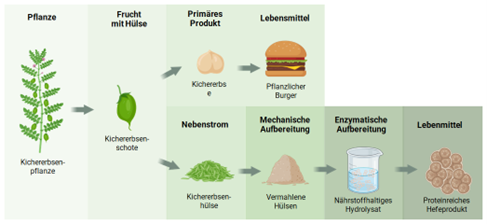
The processing of the grains produces by-products such as husks and other plant parts. Until now, these have been processed in mills and mainly used as animal feed or added to food as fiber.
At the same time, a great deal of expertise has been built up in recent years in the production of plant-based, protein-rich foods. ProteinDistillery's technology makes it possible to produce protein-containing products from yeast-containing side streams that closely mimic the properties of animal protein.
Another technological advance is the discovery of new, highly specialized enzymes. These are identified using bioinformatic tools that can predict enzyme activities and specificities. The company Candidum specializes in enzyme development and industrial biotechnology.
In this project, the husks of field beans and chickpeas are to be used as raw material for yeast fermentation to obtain protein. Monsheimer Mühle supplies the mechanically processed husks for this purpose. At the NMI, enzymatic breakdown is carried out using enzymes from Candidum, and ProteinDistillery optimizes protein production with the help of adapted yeast strains.
Period:
01.11.2025 - 31.10.2027FKZ:
BWFE25073Projectlead


NMI Natural and Medical Sciences Institute
at the University of Tübingen
Markwiesenstraße 55, 72770 Reutlingen
Tel.: +49 7121 51530-0
Mail:
info@nmi.de
Follow us now